PoliticalTests
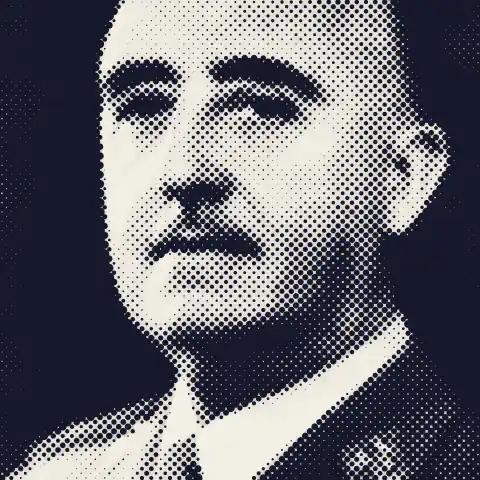
Portrait of Francisco Franco
1892-1975Spain

Portrait: Unknown author, CC0, via Wikimedia Commons

Francisco Franco

Head of State of Spain (1939-1975) · Prime Minister of Spain (1939-1973) · Leader of the Nationalist side in the Spanish Civil War (1936-1939) · Army general

Spanish general who led the Nationalist side in the Civil War of 1936 to 1939 and ruled Spain as dictator until his death in 1975, under a Catholic, anticommunist and centralist regime.

ECONOMYSTATE AND LIBERTYSOCIETYWORLDOwnershipMarketsWelfareAuthoritySecurityStructureMoralityReligionTechnologyCultureTradeForeign
  • Position
  • Solid, past the ring: second pole
  • Short, inside the ring: first pole
  • Balanced

★ Francisco Franco on 12 axes

Share of each pole

Economy

Equality / Markets
  • OwnershipMild: Private
    PublicPrivate
  • MarketsMild: Planned
    PlannedFree
  • WelfareMild: Self-reliant
    SharedSelf-reliant

State and liberty

Liberty / Authority
  • AuthorityStrong: Strong leader
    DemocraticStrong leader
  • SecurityStrong: Order
    LibertyOrder
  • StructureStrong: Central
    LocalCentral

Society

Progress / Tradition
  • MoralityStrong: Traditional
    ProgressiveTraditional
  • ReligionStrong: Religious
    SecularReligious
  • TechnologyNo clear record
    EmbraceCaution
  • CultureStrong: National identity
    MulticulturalNational identity

World

Global / Nation
  • TradeModerate: Protected
    GlobalProtected
  • Foreign policyModerate: Strength
    CooperationStrength

How we placed it

Judgment calls

Positions summarize typical stances from primary sources and reference works. Where an axis is genuinely contested, the reasoning is below.

Markets
Averages two phases: state-directed autarky in the 1940s and the market opening of the 1959 Stabilization Plan, run by technocrat ministers.
Welfare
The regime built paternalist labor protections and later social insurance, but within a system of banned independent unions and low social spending, so a near neutral score is used.
Technology
No reasonable basis for views on modern technology questions.
Trade
Autarky and import controls dominated until 1959, after which Spain opened to foreign trade and investment and applied to join the European Economic Community in 1962.
Foreign policy
Kept Spain formally out of the Second World War while sending the Blue Division to fight the Soviet Union, then aligned with the United States through the 1953 bases agreement.

One axis is marked as no clear record: there is no reasonable basis to place Francisco Franco there, so matching leaves it out.

Who was Francisco Franco?

Francisco Franco Bahamonde, born in Ferrol in 1892, made his name as an officer in the colonial war in Morocco and became Europe's youngest general in 1926. He joined the military uprising against the Second Republic in July 1936, received German and Italian support, and in October 1936 the rebels named him head of state. After victory in 1939 he governed with unlimited personal power, also serving as head of government until 1973. In 1969 he named Juan Carlos de Borbón as his successor, and he died in Madrid in November 1975.

Political views

  • Ruled without elections or legal opposition; after the war about 270,000 opponents were imprisoned and tens of thousands died.

    Source: dhm.de
  • Signed a 1953 concordat declaring Catholicism the only religion of the Spanish nation, the basis of the regime's National Catholicism.

    Source: vatican.va
  • Governed a centralized state that persecuted public use of Catalan, Basque and Galician, a policy Spain's 2022 Democratic Memory Law formally recognizes.

    Source: boe.es
  • Declared neutrality in 1939 and non-belligerence in 1940, met Hitler at Hendaye, and sent the volunteer Blue Division to fight alongside the Wehrmacht against the Soviet Union.

    Source: dhm.de
  • Granted the United States military bases in 1953 in exchange for economic and military aid, ending much of Spain's post-war isolation.

    Source: encyclopedia.com
  • Replaced autarky with the 1959 Stabilization Plan, opening the economy and preceding the rapid growth of the 1960s.

    Source: dhm.de

Legacy

Franco remains the most divisive figure in modern Spanish history. Supporters at the time credited him with defeating a revolutionary left, keeping Spain out of the Second World War and presiding over the economic growth of the 1960s. Historians such as Paul Preston stress the scale of repression during and after the war, with estimates of around 20,000 to 50,000 executions after 1939 alone, the mass graves still being excavated, forced labor and decades of censorship and political imprisonment. Scholars debate whether the regime was fascist: the Falange and the early alliance with Hitler and Mussolini point that way, while many historians describe a conservative, Catholic and military dictatorship that later relied on technocrats. Democratic Spain passed memory laws in 2007 and 2022, and his remains were moved from the Valley of the Fallen in 2019.

★ Free · 12 Axes Political Test ★

How close are you to Francisco Franco?

Take the free 12 Axes test to see your match with Francisco Franco and 347 other historical figures, axis by axis.

OptionalWant every axis explained? The Full Political Profile is an optional $9.99 deep dive. See what is inside

FAQ

Francisco Franco: questions

Was Francisco Franco a fascist?

Historians disagree. His regime used the fascist Falange as its single party and was allied with Hitler and Mussolini early on, but many scholars describe it as a conservative, Catholic military dictatorship rather than a fully fascist one.

How long did Franco rule Spain?

He was head of state from the end of the Civil War in 1939, and of the Nationalist zone from 1936, until his death on 20 November 1975.

Who succeeded Franco?

In 1969 he named Juan Carlos de Borbón as his successor. Juan Carlos became king in November 1975 and supported the transition to democracy.