PoliticalTests
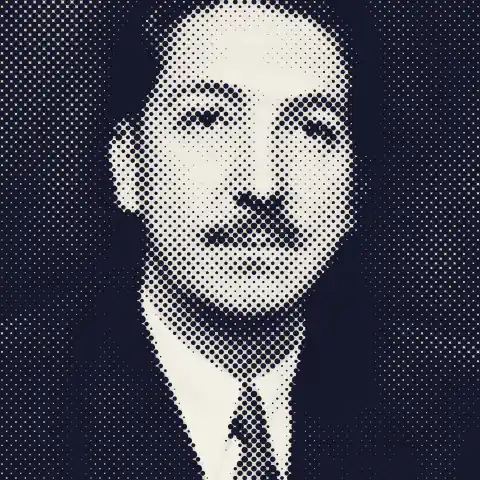
Portrait of Miguel Alemán Valdés
1900-1983Mexico

Portrait: Harris & Ewing, photographer, Public domain, via Wikimedia Commons

Miguel Alemán Valdés

President of Mexico (1946-1952) · Secretary of the Interior (1940-1945) · Governor of Veracruz (1936-1939) · Senator for Veracruz (1934-1936) · Lawyer

Mexico's first civilian president after a line of revolutionary generals, who made industrialization the national priority, built highways, dams and the Ciudad Universitaria and tied labor unions closely to the government.

ECONOMYSTATE AND LIBERTYSOCIETYWORLDOwnershipMarketsWelfareAuthoritySecurityStructureMoralityReligionTechnologyCultureTradeForeign
  • Position
  • Solid, past the ring: second pole
  • Short, inside the ring: first pole
  • Balanced

★ Miguel Alemán Valdés on 12 axes

Share of each pole

Economy

Equality / Markets
  • OwnershipMild: Private
    PublicPrivate
  • MarketsMild: Planned
    PlannedFree
  • WelfareMild: Self-reliant
    SharedSelf-reliant

State and liberty

Liberty / Authority
  • AuthorityModerate: Strong leader
    DemocraticStrong leader
  • SecurityModerate: Order
    LibertyOrder
  • StructureModerate: Central
    LocalCentral

Society

Progress / Tradition
  • MoralityNo clear record
    ProgressiveTraditional
  • ReligionMild: Secular
    SecularReligious
  • TechnologyNo clear record
    EmbraceCaution
  • CultureMild: National identity
    MulticulturalNational identity

World

Global / Nation
  • TradeModerate: Protected
    GlobalProtected
  • Foreign policyBalanced
    CooperationStrength

How we placed it

Judgment calls

Positions summarize typical stances from primary sources and reference works. Where an axis is genuinely contested, the reasoning is below.

Ownership
He kept Pemex and other state firms but made private and foreign capital the engine of industrialization and stopped the land reform, so the score sits slightly on the private side.
Markets
A 1950 law gave the executive power to fix prices and regulate imports and exports, alongside heavy public investment, which keeps the score near the middle despite his pro-business reputation.
Authority
Governed in a dominant-party system, imposed government-friendly union leaders and outlawed the Communist Party, while respecting the one-term rule and handing over power in 1952.
Morality
No documented basis on family or personal morality beyond granting women the vote in municipal elections; left null.
Foreign policy
Aligned Mexico closely with the United States in the early Cold War but refused to send troops to Korea; no strong position is assigned.

2 axes are marked as no clear record: there is no reasonable basis to place Miguel Alemán Valdés there, so matching leaves them out.

Who was Miguel Alemán Valdés?

Miguel Alemán Valdés was born in Sayula, Veracruz, studied law in Mexico City and represented workers before entering politics. He served as senator and governor of Veracruz, ran Manuel Ávila Camacho's presidential campaign and was interior secretary from 1940 to 1945. As candidate of the newly renamed Institutional Revolutionary Party (PRI) he won the 1946 election with about 78 percent of the vote. His term from 1946 to 1952 is associated with the start of the so-called Mexican Miracle of rapid growth. He later headed the national tourism council from 1961 until his death in 1983.

Political views

  • Made industrialization the national priority, with tax incentives, public credit and more than 11,000 kilometers of new highways, and declared that US capital would be welcome.

    Source: memoriapoliticademexico.org
  • Amended Article 27 to protect agricultural and ranching properties from expropriation, which slowed the land reform.

    Source: memoriapoliticademexico.org
  • Backed the imposition of government-aligned union leaders, known as charros, starting with the railway workers' union in 1948.

    Source: en.wikipedia.org
  • Defended tariff protection at the Havana trade conference and kept Mexico out of the GATT, while devaluing the peso in 1949.

    Source: memoriapoliticademexico.org
  • Created the Federal Security Directorate, a political police agency attached to the interior ministry, in 1947.

    Source: en.wikipedia.org
  • Governed with a firmly anti-communist line, and the Mexican Communist Party was declared illegal during his term.

    Source: memoriapoliticademexico.org
  • Added the crime of 'social dissolution' to the penal code in 1950, a provision later used against dissidents and opposed by the 1968 student movement.

    Source: memoriapoliticademexico.org
  • Promulgated the 1947 reform of Article 115 of the Constitution, which recognized women's right to vote and stand for office in municipal elections.

    Source: cndh.org.mx

Legacy

Admirers see Alemán as the modernizer who turned a rural country toward industry, cities, tourism and higher education, and the Ciudad Universitaria, Mexico City's airport and Acapulco's growth are often linked to his name. Critics argue that he ended the redistributive phase of the Revolution, favored business allies and foreign capital, and placed unions under leaders loyal to the government. His administration is widely remembered for the personal enrichment of the president and his circle, and the security agency and penal provisions he created were later used against opponents of the PRI.

★ Free · 12 Axes Political Test ★

How close are you to Miguel Alemán Valdés?

Take the free 12 Axes test to see your match with Miguel Alemán Valdés and 347 other historical figures, axis by axis.

OptionalWant every axis explained? The Full Political Profile is an optional $9.99 deep dive. See what is inside

FAQ

Miguel Alemán Valdés: questions

What is Miguel Alemán known for?

He was Mexico's first civilian president after the revolutionary generals. His term from 1946 to 1952 is known for rapid industrialization, new highways and dams, the Ciudad Universitaria and the growth of Acapulco.

Was Miguel Alemán left or right?

He is usually placed on the right wing of the PRI of his era. He favored private and foreign investment and anti-communist measures, while keeping state oil, trade protection and strong economic powers for the government.