PoliticalTests
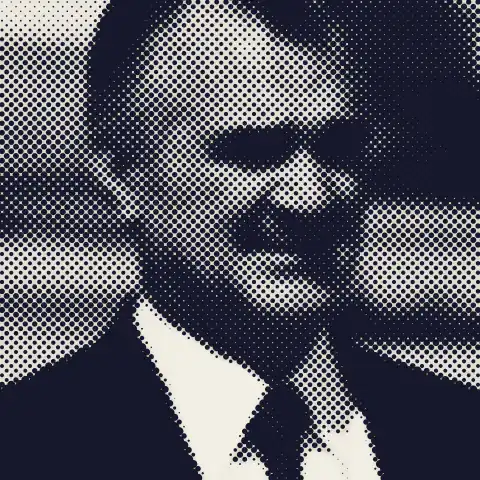
Portrait of Miguel de la Madrid
1934-2012Mexico

Portrait: SGT ROBERT S. CHAMBERS III, Public domain, via Wikimedia Commons

Miguel de la Madrid

President of Mexico (1982-1988) · Secretary of Programming and Budget (1979-1981) · Undersecretary of Finance (1975-1979) · Director of the Fondo de Cultura Económica (1990-2000) · Lawyer

Mexican president who took office in the 1982 debt crisis, imposed austerity, began opening the economy and joined the GATT in 1986, and ended his term with the disputed 1988 election.

ECONOMYSTATE AND LIBERTYSOCIETYWORLDOwnershipMarketsWelfareAuthoritySecurityStructureMoralityReligionTechnologyCultureTradeForeign
  • Position
  • Solid, past the ring: second pole
  • Short, inside the ring: first pole
  • Balanced

★ Miguel de la Madrid on 12 axes

Share of each pole

Economy

Equality / Markets
  • OwnershipModerate: Private
    PublicPrivate
  • MarketsMild: Free
    PlannedFree
  • WelfareMild: Self-reliant
    SharedSelf-reliant

State and liberty

Liberty / Authority
  • AuthorityModerate: Strong leader
    DemocraticStrong leader
  • SecurityMild: Order
    LibertyOrder
  • StructureModerate: Central
    LocalCentral

Society

Progress / Tradition
  • MoralityNo clear record
    ProgressiveTraditional
  • ReligionMild: Secular
    SecularReligious
  • TechnologyNo clear record
    EmbraceCaution
  • CultureNo clear record
    MulticulturalNational identity

World

Global / Nation
  • TradeMild: Global
    GlobalProtected
  • Foreign policyModerate: Cooperation
    CooperationStrength

How we placed it

Judgment calls

Positions summarize typical stances from primary sources and reference works. Where an axis is genuinely contested, the reasoning is below.

Ownership
The number of state-owned companies fell from about 1,155 to 412 during his term through sales, mergers and closures, though Pemex, the electricity sector and the banks nationalized in 1982 stayed public.
Authority
Governed within the PRI's dominant-party system and oversaw the disputed 1988 election, which the opposition called fraudulent; he was later reported to have said he had ordered the army ready to act if protesters tried to seize the National Palace.
Security
Thin record beyond the 1988 events and his anti-corruption prosecutions of former officials; scored slightly toward order.
Religion
Kept the constitutional restrictions on the Church inherited from the revolutionary settlement; no move of his own is documented.
Foreign policy
Scored on his role in founding the Contadora Group to seek negotiated peace in Central America.

3 axes are marked as no clear record: there is no reasonable basis to place Miguel de la Madrid there, so matching leaves them out.

Who was Miguel de la Madrid?

Miguel de la Madrid Hurtado was born in Colima, studied law at the National Autonomous University and public administration at Harvard. He worked at the central bank, Pemex and the finance ministry, and became secretary of programming and budget in 1979. He took office on 1 December 1982 with inflation near 100 percent and foreign debt of about 87 billion dollars after the oil price collapse and the bank nationalization of his predecessor. His term saw the 1985 Mexico City earthquake and ended with the 1988 election of Carlos Salinas. From 1990 to 2000 he directed the state publisher Fondo de Cultura Económica. He died in 2012.

Political views

  • Launched an immediate economic reordering program in 1983 with spending cuts and austerity to restore public finances.

    Source: cidob.org
  • Reduced the number of state-owned companies from about 1,155 in 1982 to 412 in 1988 through sales, mergers and closures.

    Source: en.wikipedia.org
  • Took Mexico into the General Agreement on Tariffs and Trade (GATT) in 1986, beginning a turn away from trade protection.

    Source: wto.org
  • Ran an anti-corruption campaign that led to the prosecution of former Mexico City police chief Arturo Durazo and former Pemex director Jorge Díaz Serrano.

    Source: cidob.org
  • Signed the 1987 Economic Solidarity Pact with business and labor to fight inflation through agreed wages and prices.

    Source: cidob.org
  • Helped found the Contadora Group with Colombia, Venezuela and Panama in 1983 to seek peace in Central America.

    Source: cidob.org

Legacy

Supporters credit de la Madrid with steering Mexico through its worst economic crisis since the Revolution and starting the market reforms and trade opening that his successors extended. Critics point to falling real wages, high inflation for most of his term and the government's slow response to the 1985 earthquake, including its initial refusal of foreign aid. The 1988 election, in which the vote count stopped after a computer failure and Salinas was declared the winner over Cuauhtémoc Cárdenas, remains his most debated legacy. Statements attributed to him in later years were read by many as an admission of fraud, and he called Salinas a criminal in a 2009 interview before retracting the remarks.

★ Free · 12 Axes Political Test ★

How close are you to Miguel de la Madrid?

Take the free 12 Axes test to see your match with Miguel de la Madrid and 347 other historical figures, axis by axis.

OptionalWant every axis explained? The Full Political Profile is an optional $9.99 deep dive. See what is inside

FAQ

Miguel de la Madrid: questions

What happened in the 1988 Mexican election?

During the count the electoral computer system went down, and when results resumed Carlos Salinas of the PRI was declared the winner with about 50 percent. Cuauhtémoc Cárdenas and other opposition candidates called it fraud.

Was Miguel de la Madrid a neoliberal?

He is often seen as the president who began Mexico's shift toward market economics, with austerity, a first wave of privatization and entry into the GATT, a course his successor Carlos Salinas took much further.