
PoliticalTests
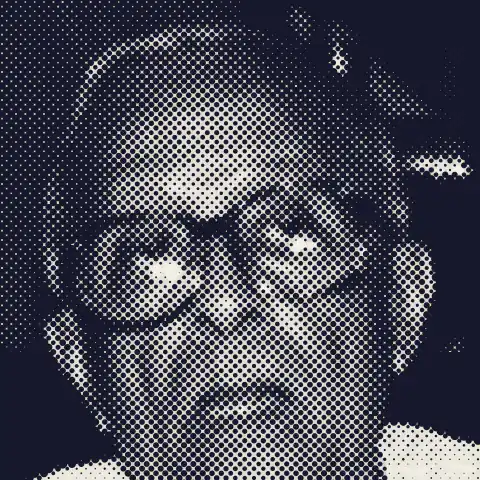
Portrait of Jyoti Basu
1914-2010India

Portrait: Biswarup Ganguly, CC BY-SA 3.0, via Wikimedia Commons. Halftone version: CC BY-SA 3.0

Jyoti Basu

Chief Minister of West Bengal (1977-2000) · Deputy Chief Minister of West Bengal in the United Front governments of 1967 and 1969 · Founding member of the Politburo of the Communist Party of India (Marxist) · Trade union organiser and Member of the West Bengal Legislative Assembly

Communist leader who governed West Bengal for 23 years, carried out land reform for sharecroppers and revived village councils, and was nearly prime minister of India in 1996.

ECONOMYSTATE AND LIBERTYSOCIETYWORLDOwnershipMarketsWelfareAuthoritySecurityStructureMoralityReligionTechnologyCultureTradeForeign
  • Position
  • Solid, past the ring: second pole
  • Short, inside the ring: first pole
  • Balanced

★ Jyoti Basu on 12 axes

Share of each pole

Economy

Equality / Markets
  • OwnershipModerate: Public
    PublicPrivate
  • MarketsModerate: Planned
    PlannedFree
  • WelfareStrong: Shared
    SharedSelf-reliant

State and liberty

Liberty / Authority
  • AuthorityMild: Democratic
    DemocraticStrong leader
  • SecurityMild: Order
    LibertyOrder
  • StructureModerate: Local
    LocalCentral

Society

Progress / Tradition
  • MoralityNo clear record
    ProgressiveTraditional
  • ReligionNo clear record
    SecularReligious
  • TechnologyNo clear record
    EmbraceCaution
  • CultureNo clear record
    MulticulturalNational identity

World

Global / Nation
  • TradeNo clear record
    GlobalProtected
  • Foreign policyNo clear record
    CooperationStrength

How we placed it

Judgment calls

Positions summarize typical stances from primary sources and reference works. Where an axis is genuinely contested, the reasoning is below.

Markets
A Marxist who governed for 23 years inside India's mixed economy and was described as a pragmatic tactician; scored less planned than his party's doctrine.
Authority
Won five successive state elections and opposed the Emergency, but critics accuse his long rule of building a party-dominated society and tolerating political violence by cadres; scored mildly democratic.
Security
His government's police blockade and eviction of refugees at Marichjhapi in 1979 and the 1993 Kolkata police firing drew accusations of police brutality; scored mildly toward order.
Structure
Revived elected panchayats in 1978 and complained that New Delhi discriminated against West Bengal, though he opposed a separate Gorkhaland state; scored toward local power.
Morality
His sources here do not document clear positions on social morality, religion, technology, national culture, trade or foreign policy, so those axes are left unscored.

6 axes are marked as no clear record: there is no reasonable basis to place Jyoti Basu there, so matching leaves them out.

Who was Jyoti Basu?

Jyoti Basu was born in Calcutta in 1914 to a doctor's family and studied law in London, where he was drawn to communism. Returning in 1940, he joined the Communist Party of India and organised railway workers. He was elected to the Bengal assembly in 1946, became a founding Politburo member of the Communist Party of India (Marxist) in 1964 and served twice as deputy chief minister in United Front governments. From 1977 to 2000 he was chief minister of West Bengal at the head of the Left Front, the longest tenure in India at the time. He died in 2010.

Political views

  • Launched Operation Barga in 1978, which recorded sharecroppers and gave them legal rights to their crop share and protection from eviction.

    Source: en.wikipedia.org
  • Revived elected panchayats in 1978, holding the first local elections in West Bengal for 14 years, as part of what his government called democratic decentralisation.

    Source: en.wikipedia.org
  • Used parliamentary politics to build communist strength in West Bengal and, from 1991, led his party's tactical support for parties opposed to the BJP.

    Source: indianexpress.com
  • Called his party's decision in 1996 not to let him become prime minister of a United Front government a historic blunder.

    Source: hindustantimes.com
  • Led the CPI(M) as one of the main opponents of Indira Gandhi's Emergency rule from 1975 to 1977.

    Source: en.wikipedia.org
  • His government stopped the teaching of English in state primary schools in 1989, a decision that drew protests from intellectuals and was later called another historic blunder.

    Source: en.wikipedia.org

Legacy

Admirers credit Basu with land reform that gave security to millions of sharecroppers, with grassroots democracy through panchayats and with political stability, and the editor M. J. Akbar argued that as prime minister he could have given India's left a national role. Critics blame his long rule for the industrial decline of West Bengal, militant trade unionism, party control of institutions and political violence. The gravest charge concerns Marichjhapi in 1979, when his government blockaded and forcibly evicted Hindu refugees from Bangladesh who had settled on a protected island in the Sundarbans. The official death toll was two to eight, while survivors and the writer Deep Halder say the toll may have run into thousands, up to 10,000 by some accounts; there is no authoritative count, and Basu's government refused a formal inquiry, saying the reports were exaggerated.

★ Free · 12 Axes Political Test ★

How close are you to Jyoti Basu?

Take the free 12 Axes test to see your match with Jyoti Basu and 347 other historical figures, axis by axis.

OptionalWant every axis explained? The Full Political Profile is an optional $9.99 deep dive. See what is inside

FAQ

Jyoti Basu: questions

What political party was Jyoti Basu?

Basu joined the Communist Party of India in 1940 and in 1964 was one of the nine founding Politburo members of the Communist Party of India (Marxist). He led its Left Front government in West Bengal from 1977 to 2000.

Why did Jyoti Basu not become prime minister?

After the 1996 election, the parties of the United Front wanted Basu to lead their government, but the CPI(M) decided not to join it. H. D. Deve Gowda became prime minister instead, and Basu later called his party's decision a historic blunder.

What was Operation Barga?

It was the land reform drive his government began in 1978 to register sharecroppers, known as bargadars, so that they could claim a fixed share of the crop and could not be evicted at will.

Sources

  1. 01en.wikipedia.org
  2. 02indianexpress.com
  3. 03hindustantimes.com
  4. 04indiatoday.in
  5. 05timesofindia.indiatimes.com

Image credits

Portrait of Jyoti Basu: Jyoti Basu 006 (cropped).jpg by Biswarup Ganguly, licensed CC BY-SA 3.0, via Wikimedia Commons. Cropped, converted to grayscale and printed as a halftone by politicaltests.org; the halftone version is licensed CC BY-SA 3.0.

All portrait credits and licenses