
PoliticalTests
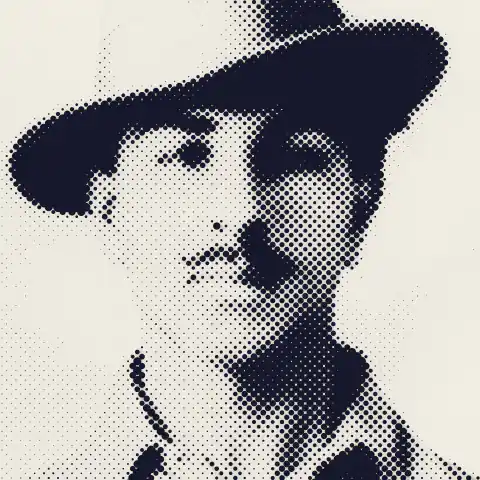
Portrait of Bhagat Singh
1907-1931India

Portrait: Unknown author Unknown author (Ramnath Photographers, Delhi), Public domain, via Wikimedia Commons

Bhagat Singh

Revolutionary in the Indian independence movement · Leader of the Hindustan Socialist Republican Association · Writer and journalist

Socialist revolutionary of the Indian independence movement who took part in the killing of a British police officer and the 1929 Assembly bombing, wrote Why I Am an Atheist and was hanged at 23.

ECONOMYSTATE AND LIBERTYSOCIETYWORLDOwnershipMarketsWelfareAuthoritySecurityStructureMoralityReligionTechnologyCultureTradeForeign
  • Position
  • Solid, past the ring: second pole
  • Short, inside the ring: first pole
  • Balanced

★ Bhagat Singh on 12 axes

Share of each pole

Economy

Equality / Markets
  • OwnershipStrong: Public
    PublicPrivate
  • MarketsStrong: Planned
    PlannedFree
  • WelfareModerate: Shared
    SharedSelf-reliant

State and liberty

Liberty / Authority
  • AuthorityModerate: Strong leader
    DemocraticStrong leader
  • SecurityMild: Liberty
    LibertyOrder
  • StructureNo clear record
    LocalCentral

Society

Progress / Tradition
  • MoralityNo clear record
    ProgressiveTraditional
  • ReligionStrong: Secular
    SecularReligious
  • TechnologyNo clear record
    EmbraceCaution
  • CultureNo clear record
    MulticulturalNational identity

World

Global / Nation
  • TradeNo clear record
    GlobalProtected
  • Foreign policyNo clear record
    CooperationStrength

How we placed it

Judgment calls

Positions summarize typical stances from primary sources and reference works. Where an axis is genuinely contested, the reasoning is below.

Ownership
Defined revolution as the complete overthrow of the existing social order and its replacement with a socialist one, and urged the youth to adopt Marxism; scored strongly toward public ownership and planning.
Authority
Wanted power transferred to a revolutionary party with popular support to rebuild society on socialist lines, and admired Lenin; scored toward a strong revolutionary state rather than pluralist checks.
Security
Bombed the Central Legislative Assembly in protest against the Public Safety Bill and the Trade Disputes Act, which curbed political and labour activity; scored mildly toward liberty against colonial repression, though he defended political violence.
Structure
He was executed at 23, and his writings here do not set out clear positions on central versus local power, social morality, technology, national culture, trade or foreign policy, so those axes are left unscored.

6 axes are marked as no clear record: there is no reasonable basis to place Bhagat Singh there, so matching leaves them out.

Who was Bhagat Singh?

Bhagat Singh was born in 1907 into a Sikh family of nationalists in Lyallpur district, Punjab, now in Pakistan, and studied at the National College in Lahore. He wrote for Punjabi and Urdu papers and helped turn the Hindustan Republican Association into the Hindustan Socialist Republican Association in 1928. After the police baton charge that preceded the death of Lala Lajpat Rai, he and Shivaram Rajguru shot dead the police officer John Saunders in December 1928, mistaking him for his superior. In April 1929 he and Batukeshwar Dutt threw bombs designed not to kill into the Central Legislative Assembly and courted arrest. He was hanged in Lahore with Rajguru and Sukhdev on 23 March 1931.

Political views

  • Defined revolution as the complete overthrow of the existing social order and its replacement with a socialist order, with power held by a revolutionary party with popular support.

    Source: marxists.org
  • Argued that the real forces of any revolution were the peasants and workers, and criticised Congress leaders for not daring to organise them.

    Source: marxists.org
  • Wrote in his last months that he was not a terrorist but a revolutionary, and that nothing could be gained by terrorist methods, though he did not call bombs and pistols useless.

    Source: marxists.org
  • Explained in Why I Am an Atheist that he had abandoned belief in God, and argued that criticism and independent thinking were the indispensable qualities of a revolutionary.

    Source: marxists.org
  • Planned the Assembly bombing as a protest against the Public Safety Bill and the Trade Disputes Act, using the trial as a platform to publicise the cause, and joined a prison hunger strike for better treatment of Indian prisoners.

    Source: en.wikipedia.org

Legacy

Bhagat Singh is honoured in India as Shaheed-e-Azam, the great martyr, and leaders of every political stripe pay tribute on the anniversary of his execution. Communists stress his Marxism and atheism, while Hindu nationalists and others claim him as a patriot, and the contest over his legacy continues. At the time, Mahatma Gandhi condemned the Saunders killing as a retrograde step and many nationalists insisted that non-cooperation was better than violence. Nehru later wrote that Singh became popular not for his act of terrorism but because he seemed to vindicate the honour of Lala Lajpat Rai and of the nation. Critics of political violence point out that the Saunders killing also led to the death of an Indian head constable, Channan Singh.

In their words

Any man who stands for progress has to criticise, disbelieve and challenge every item of the old faith.
Why I Am an Atheist, written in prison, October 1930

★ Free · 12 Axes Political Test ★

How close are you to Bhagat Singh?

Take the free 12 Axes test to see your match with Bhagat Singh and 347 other historical figures, axis by axis.

OptionalWant every axis explained? The Full Political Profile is an optional $9.99 deep dive. See what is inside

FAQ

Bhagat Singh: questions

What political party was Bhagat Singh?

Bhagat Singh belonged to the Hindustan Socialist Republican Association, a revolutionary group he helped rename and reorganise in 1928. He was also active in the Naujawan Bharat Sabha, a youth organisation in Punjab.

Was Bhagat Singh a communist?

In his final writings he called himself a revolutionary socialist, admired Lenin and urged young activists to adopt Marxism and organise workers and peasants. He was executed before the Communist Party became a major force, so he never held party membership.

Why was Bhagat Singh hanged?

He was convicted in the Lahore Conspiracy Case of the 1928 murder of police officer John Saunders and of head constable Channan Singh, and hanged with Rajguru and Sukhdev in Lahore on 23 March 1931.