PoliticalTests
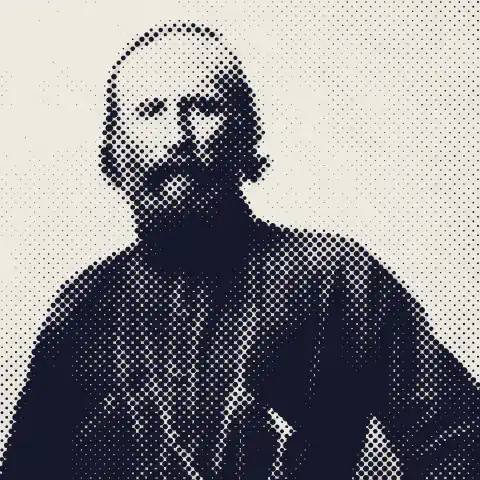
Portrait of Giuseppe Garibaldi
1807-1882Italy

Portrait: In album: Cartes-de-visite portraits of U.S, Public domain, via Wikimedia Commons

Giuseppe Garibaldi

Revolutionary general, leader of the Expedition of the Thousand (1860) · Hero of the Italian Risorgimento and the Uruguayan Civil War · Member of the Italian Chamber of Deputies

Italian general and patriot whose volunteer campaigns, above all the 1860 Expedition of the Thousand, were central to the unification of Italy and made him a worldwide symbol of national liberation.

ECONOMYSTATE AND LIBERTYSOCIETYWORLDOwnershipMarketsWelfareAuthoritySecurityStructureMoralityReligionTechnologyCultureTradeForeign
  • Position
  • Solid, past the ring: second pole
  • Short, inside the ring: first pole
  • Balanced

★ Giuseppe Garibaldi on 12 axes

Share of each pole

Economy

Equality / Markets
  • OwnershipMild: Public
    PublicPrivate
  • MarketsNo clear record
    PlannedFree
  • WelfareMild: Shared
    SharedSelf-reliant

State and liberty

Liberty / Authority
  • AuthorityMild: Democratic
    DemocraticStrong leader
  • SecurityNo clear record
    LibertyOrder
  • StructureModerate: Central
    LocalCentral

Society

Progress / Tradition
  • MoralityMild: Progressive
    ProgressiveTraditional
  • ReligionStrong: Secular
    SecularReligious
  • TechnologyNo clear record
    EmbraceCaution
  • CultureNo clear record
    MulticulturalNational identity

World

Global / Nation
  • TradeNo clear record
    GlobalProtected
  • Foreign policyMild: Strength
    CooperationStrength

How we placed it

Judgment calls

Positions summarize typical stances from primary sources and reference works. Where an axis is genuinely contested, the reasoning is below.

Ownership
Hailed the First International as "the sun of the future" but did not share its calls to abolish private property; scored near neutral.
Welfare
Leaned toward an ethical, egalitarian socialism and backed public works and land reclamation for the poor countryside.
Authority
A republican who backed universal suffrage, yet ruled Sicily as dictator in 1860 before handing it to the king; scored near neutral.
Structure
Fought for a single united Italy and accepted unification under the monarchy rather than a federation.
Morality
His League of Democracy of 1879 called for the legal and political emancipation of women.
Religion
Fiercely anticlerical: he called for abolishing the papacy and tried twice to take Rome from the Pope by force.
Culture
Combined Italian patriotism with a universal brotherhood of nations; no clear position on immigration, left null.
Foreign policy
Saw armed volunteers as the way to free nations in Italy, South America and France, while also joining the League of Peace and Freedom; scored mildly toward strength.

5 axes are marked as no clear record: there is no reasonable basis to place Giuseppe Garibaldi there, so matching leaves them out.

Who was Giuseppe Garibaldi?

Giuseppe Garibaldi was born in Nice, then part of the Kingdom of Sardinia, and became a sailor before joining Giuseppe Mazzini's Young Italy. Sentenced to death after a failed rising in 1834, he fled to South America, where he fought for the Rio Grande rebels and for Uruguay at the head of an Italian Legion, the first Redshirts. He returned in 1848 and defended the Roman Republic in 1849. In 1860 he led about a thousand volunteers to Sicily, conquered the Kingdom of the Two Sicilies and handed it to Victor Emmanuel II at Teano. Failed marches on Rome followed in 1862 and 1867. He sat as a deputy of the left and retired to the island of Caprera.

Political views

  • Adopted the republican nationalism of Mazzini's Young Italy, but agreed to unite Italy under the Savoy monarchy when that proved possible.

    Source: en.wikipedia.org
  • Declared himself dictator of Sicily in the name of Victor Emmanuel in 1860 and later surrendered his conquests to the king.

    Source: en.wikipedia.org
  • Proposed at the 1867 congress of the League of Peace and Freedom that the papacy be abolished.

    Source: en.wikipedia.org
  • Defended the Paris Commune and called the First International "the sun of the future", while rejecting the abolition of property.

    Source: en.wikipedia.org
  • Founded the League of Democracy in 1879 to campaign for universal suffrage, the end of Church property and the emancipation of women.

    Source: en.wikipedia.org
  • Attacked Cavour in parliament in 1860 for ceding his native Nice to France.

    Source: en.wikipedia.org

Legacy

Garibaldi is Italy's best-known national hero, honoured with statues in squares across the country and celebrated in his lifetime from London to New York as the "hero of two worlds". Admirers see him as a selfless fighter for freedom who refused rewards after giving southern Italy to the king. Catholics of his day saw him as an enemy of the Church, and many southern Italians later linked unification with conquest by the north and the hard years that followed. Historians such as Denis Mack Smith have stressed his political naivety and his clashes with Cavour, while others note that his fame owed much to skilled publicity by his supporters. Fascists, communists and liberals have all claimed his memory.

★ Free · 12 Axes Political Test ★

How close are you to Giuseppe Garibaldi?

Take the free 12 Axes test to see your match with Giuseppe Garibaldi and 347 other historical figures, axis by axis.

OptionalWant every axis explained? The Full Political Profile is an optional $9.99 deep dive. See what is inside

FAQ

Giuseppe Garibaldi: questions

What did Garibaldi do for Italy?

In 1860 he led the Expedition of the Thousand that conquered Sicily and southern Italy and handed it to King Victor Emmanuel II, a decisive step toward the united Kingdom of Italy proclaimed in 1861.

Was Garibaldi a republican?

Yes, by conviction, but he accepted unification under the Savoy monarchy as the practical route to a united Italy, which put him at odds with Mazzini.

Was Garibaldi a socialist?

He praised the First International and an ethical socialism of justice for the poor, but he did not support abolishing private property.