Canadian citizenship test practice
Twenty random questions, the real pass mark of 15, and every answer explained with the chapter of Discover Canada it comes from.
- 20 questions
- Pass with 15
- 80 in the bank
- Free, no signup
Ready?
20 questions.
Not affiliated with IRCC or the Government of Canada. Original practice questions based on Discover Canada; check canada.ca before your test.
The real test
How the real test works
- Questions
- 20
- Time
- 45
- To pass
- 15
- Chances
- 3
multiple choice or true/false
minutes
correct answers
to pass the test
If you are 18 to 54 years old on the day you sign your citizenship application, you have to take the test. Most applicants take it online, monitored by webcam, after an invitation from IRCC, and have 30 days to complete it. Accommodated tests are held in person or on Microsoft Teams.
The test has 20 questions, multiple choice or true or false, in English or French. You have 45 minutes and need at least 15 correct to pass. You get 3 chances to pass, and the test does not grade your English or French.
All questions are based on Discover Canada: The Rights and Responsibilities of Citizenship, which you can read online or download free from canada.ca.
Every question here is our own, written from facts in Discover Canada, the official study guide. The real test asks about Canada's history, geography, economy, government, laws and symbols, so the bank covers the same chapters in roughly the same mix.
Discover Canada was published in 2012, so a few of its facts are out of date. Where an answer has changed, such as the Sovereign, we give the answer that is correct as of October 2026 and say so in the explanation.
Sources, checked 30 October 2026
- IRCC, Study for the citizenship test (study guide, format, passing score)
- IRCC, How the citizenship test works
- IRCC, Discover Canada: The Rights and Responsibilities of Citizenship
- IRCC, Become a Canadian citizen: apply for citizenship
Not affiliated with IRCC or the Government of Canada. Original practice questions based on Discover Canada; check canada.ca before your test.
Question bank
Canadian citizenship test questions and answers
All 80 practice questions in the bank, grouped like the chapters of Discover Canada, with the answer, a short explanation and the chapter it comes from.
Show all 80 questions and answersHide the question bank
Rights and responsibilities
- 1.
Which document, signed in England in 1215, does Discover Canada name as a root of Canadian freedoms?
AnswerMagna Carta
Magna Carta, the Great Charter of Freedoms, dates from 1215. The guide traces a tradition of ordered liberty in Canada back to it.
Source: Discover Canada, Rights and Responsibilities of Citizenship
- 2.
In what year was the Canadian Charter of Rights and Freedoms entrenched in the Constitution?
Answer1982
The Constitution was amended in 1982 to entrench the Charter. It opens by saying Canada is founded on principles that recognize the supremacy of God and the rule of law.
Source: Discover Canada, Rights and Responsibilities of Citizenship
- 3.
What does habeas corpus protect?
AnswerThe right to challenge being held unlawfully by the state
Habeas corpus comes from English common law. It lets anyone who is detained ask a court whether the detention is lawful.
Source: Discover Canada, Rights and Responsibilities of Citizenship
- 4.
What do mobility rights in the Charter allow Canadians to do?
AnswerLive and work anywhere in Canada, and enter and leave the country
Mobility rights cover living and working anywhere in Canada, entering and leaving freely, and applying for a passport.
Source: Discover Canada, Rights and Responsibilities of Citizenship
- 5.
Which of these is a legal duty of Canadian citizens?
AnswerServing on a jury when called
Serving on a jury when summoned is required by law. Other responsibilities include obeying the law, voting, helping your community and protecting the environment.
Source: Discover Canada, Rights and Responsibilities of Citizenship
- 6.
Is military service compulsory in Canada?
AnswerNo, there is no compulsory military service
Service is voluntary. Citizens can serve in the regular Canadian Forces, the reserves or the cadets, or in the Coast Guard, police and fire services.
Source: Discover Canada, Rights and Responsibilities of Citizenship
- 7.
How does Canadian law treat men and women?
AnswerAs equal under the law
Men and women are equal under the law. Spousal abuse, forced marriage, honour killings and other gender based violence are crimes and are severely punished.
Source: Discover Canada, Rights and Responsibilities of Citizenship
Who we are
- 8.
Which are the three founding peoples of Canada, according to Discover Canada?
AnswerAboriginal, French and British
The guide describes Canada as built on three founding peoples. Millions of immigrants have since helped to build the country.
Source: Discover Canada, Who We Are
- 9.
What are the three distinct groups of Aboriginal peoples in Canada?
AnswerFirst Nations, Inuit and Métis
First Nations, Inuit and Métis are recognized as distinct peoples. Their rights are protected in the Constitution.
Source: Discover Canada, Who We Are
- 10.
The Métis are of mixed Aboriginal and European ancestry. Which language do many Métis speak?
AnswerMichif
Most Métis live in the Prairie provinces. Their distinct language, Michif, mixes French and Cree.
Source: Discover Canada, Who We Are
- 11.
Which document first guaranteed the territorial rights of Aboriginal peoples?
AnswerThe Royal Proclamation of 1763
King George III issued the Royal Proclamation in 1763. Today Aboriginal and treaty rights are protected in the Constitution.
Source: Discover Canada, Who We Are
- 12.
In what year did the Government of Canada formally apologize to former students of residential schools?
Answer2008
Residential schools ran from the 1800s to the 1980s. Many students were abused and taken from their families and culture.
Source: Discover Canada, Who We Are
- 13.
What was the Great Upheaval?
AnswerThe deportation of most Acadians from their homeland between 1755 and 1763
During the war between Britain and France, more than two thirds of the Acadians were deported. Acadian culture survived and thrives today.
Source: Discover Canada, Who We Are
- 14.
Which is the only officially bilingual province?
AnswerNew Brunswick
About one third of New Brunswick's people live and work in French. Federal services are offered in English and French across Canada.
Source: Discover Canada, Who We Are
- 15.
What did the House of Commons recognize in 2006?
AnswerThat the Québécois form a nation within a united Canada
The House of Commons passed a motion in 2006 recognizing that the Québécois form a nation within a united Canada.
Source: Discover Canada, Who We Are
Canada's history
- 16.
Where are the remains of a Viking settlement in Canada, now a UNESCO World Heritage Site?
AnswerL'Anse aux Meadows, Newfoundland
Vikings from Iceland who had colonized Greenland reached Labrador and Newfoundland about 1,000 years ago.
Source: Discover Canada, Canada's History
- 17.
Who was the first explorer to map Canada's east coast, in 1497?
AnswerJohn Cabot
Cabot, an Italian immigrant to England, sailed for England. He claimed Newfoundland or Cape Breton Island for the English king.
Source: Discover Canada, Canada's History
- 18.
The name Canada is thought to come from the Iroquoian word kanata. What does kanata mean?
AnswerVillage
Jacques Cartier heard the word from two Indigenous guides in the 1530s. By the 1550s the name Canada was appearing on maps.
Source: Discover Canada, Canada's History
- 19.
Which explorer made three voyages across the Atlantic between 1534 and 1542 and claimed the land for the King of France?
AnswerJacques Cartier
Cartier was the first European to explore the St. Lawrence River. He claimed the land for King Francis I of France.
Source: Discover Canada, Canada's History
- 20.
Who built a fortress at the site of present day Quebec City in 1608?
AnswerSamuel de Champlain
Champlain allied the colony with the Algonquin, Montagnais and Huron. Earlier, in 1604, he and Pierre de Monts founded the first European settlement north of Florida.
Source: Discover Canada, Canada's History
- 21.
What did the Battle of the Plains of Abraham in 1759 decide?
AnswerThe British defeat of the French, ending France's empire in America
The battle was fought at Quebec City. Both commanders, Brigadier James Wolfe and the Marquis de Montcalm, were killed.
Source: Discover Canada, Canada's History
- 22.
What did the Quebec Act of 1774 do?
AnswerAllowed religious freedom for Catholics and restored French civil law
Passed by the British Parliament, the Act also let Catholics hold public office. It kept British criminal law.
Source: Discover Canada, Canada's History
- 23.
Who were the United Empire Loyalists?
AnswerPeople who left the American colonies to stay loyal to the Crown
After 1776 more than 40,000 Loyalists settled in Nova Scotia and Quebec. They included Joseph Brant's Mohawks and about 3,000 Black Loyalists.
Source: Discover Canada, Canada's History
- 24.
What did the Constitutional Act of 1791 do?
AnswerDivided the Province of Quebec into Upper Canada and Lower Canada
Upper Canada later became Ontario and Lower Canada became Quebec. The Act also gave both an elected legislative assembly.
Source: Discover Canada, Canada's History
- 25.
In 1793, Upper Canada became the first province in the British Empire to move toward abolishing slavery. Who led it?
AnswerLieutenant Governor John Graves Simcoe
Simcoe also founded the City of York, today Toronto. Slavery was abolished across the British Empire in 1833.
Source: Discover Canada, Canada's History
- 26.
What is Laura Secord remembered for?
AnswerWalking about 30 km in 1813 to warn of an American attack
Her warning to Lieutenant James FitzGibbon helped win the Battle of Beaver Dams during the War of 1812.
Source: Discover Canada, Canada's History
- 27.
Which British general captured Detroit in 1812 and was killed at Queenston Heights?
AnswerMajor General Sir Isaac Brock
Brock died defending Upper Canada near Niagara Falls, but the Americans lost the battle. The war helped set today's border.
Source: Discover Canada, Canada's History
- 28.
What is responsible government?
AnswerMinisters must have the support of a majority in the elected assembly to govern
Nova Scotia was the first British North American colony to gain full responsible government, in 1847 to 1848.
Source: Discover Canada, Canada's History
- 29.
Which four provinces formed the Dominion of Canada in 1867?
AnswerOntario, Quebec, Nova Scotia and New Brunswick
The British North America Act created the Dominion of Canada on July 1, 1867, celebrated today as Canada Day.
Source: Discover Canada, Canada's History
- 30.
Who was Canada's first Prime Minister?
AnswerSir John A. Macdonald
Macdonald became Prime Minister in 1867. Born in Scotland, he was a lawyer in Kingston, and his portrait is on the $10 bill.
Source: Discover Canada, Canada's History
- 31.
Who led the Métis at Red River in 1869 to 1870 and again in the North West in 1885?
AnswerLouis Riel
The first uprising led to the creation of Manitoba in 1870. After the second, Riel was tried and executed for high treason.
Source: Discover Canada, Canada's History
- 32.
The North West Mounted Police, founded in 1873, became which force?
AnswerThe Royal Canadian Mounted Police (RCMP)
Prime Minister Macdonald created the NWMP to bring order to the West. The RCMP is now the national police force.
Source: Discover Canada, Canada's History
- 33.
What was finished in 1885 when the last spike was driven?
AnswerThe Canadian Pacific Railway from coast to coast
British Columbia had joined Canada in 1871 on the promise of a railway to the West Coast. Chinese workers who helped build it faced the Head Tax.
Source: Discover Canada, Canada's History
- 34.
Which was the last province to join Canada, in 1949?
AnswerNewfoundland and Labrador
Alberta and Saskatchewan joined in 1905. Nunavut, a territory, was created later, in 1999.
Source: Discover Canada, Canada's History
- 35.
In April 1917, Canadian soldiers captured which ridge in France at the cost of about 10,000 killed or wounded?
AnswerVimy Ridge
Vimy Day is marked on April 9. The Canadian victory there became a symbol of national pride.
Source: Discover Canada, Canada's History
- 36.
Which was the first province to give women the right to vote, in 1916?
AnswerManitoba
Most women aged 21 and over won the federal vote in 1918. Quebec granted women the vote in 1940.
Source: Discover Canada, Canada's History
- 37.
Who became the first woman elected to the House of Commons, in 1921?
AnswerAgnes Macphail
Agnes Macphail was a farmer and teacher. Dr. Emily Stowe founded the women's suffrage movement in Canada.
Source: Discover Canada, Canada's History
- 38.
Which beach in Normandy did Canadian troops capture on D-Day, June 6, 1944?
AnswerJuno Beach
About 15,000 Canadians landed on Juno Beach. Canadian forces went on to liberate the Netherlands in 1944 to 1945.
Source: Discover Canada, Canada's History
- 39.
Who wrote the poem In Flanders Fields during the First World War?
AnswerLieutenant Colonel John McCrae
McCrae was a medical officer. Canadians wear a red poppy and keep a moment of silence on Remembrance Day, November 11.
Source: Discover Canada, Canada's History
Modern Canada
- 40.
What was the Quiet Revolution?
AnswerA period of rapid change in Quebec in the 1960s
Many Quebecers wanted to separate from Canada in this period. Quebec voters rejected sovereignty in referendums in 1980 and 1995.
Source: Discover Canada, Modern Canada
- 41.
Which law, passed by Parliament in 1969, guarantees French and English services in the federal government?
AnswerThe Official Languages Act
It made English and French equal in Parliament and in federal institutions.
Source: Discover Canada, Canadian Symbols
- 42.
Which two Canadians discovered insulin?
AnswerSir Frederick Banting and Charles Best
Insulin, a treatment for diabetes, has saved millions of lives around the world.
Source: Discover Canada, Modern Canada
- 43.
What did Terry Fox start in 1980 after losing a leg to cancer?
AnswerThe Marathon of Hope, a run across Canada for cancer research
Fox could not finish the run, but a yearly fundraising run in his name continues. Rick Hansen wheeled around the world in 1985.
Source: Discover Canada, Modern Canada
- 44.
Which joint command did Canada form with the United States to defend North America during the Cold War?
AnswerNORAD
Canada also joined NATO, a military alliance of Western democracies, and the United Nations.
Source: Discover Canada, Modern Canada
Government, elections and justice
- 45.
Which three terms describe Canada's system of government?
AnswerFederal state, parliamentary democracy and constitutional monarchy
The Constitution Act, 1867 set out the federal and provincial responsibilities.
Source: Discover Canada, How Canadians Govern Themselves
- 46.
As of October 2026, who is Canada's Head of State?
AnswerKing Charles III
Can change: correct as of 30 October 2026
Canada is a constitutional monarchy and the Sovereign is Head of State. Discover Canada (2012) names Queen Elizabeth II, who died in 2022.
Source: Discover Canada, How Canadians Govern Themselves; Governor General of Canada, gg.ca
- 47.
Who represents the Sovereign in Canada as a whole?
AnswerThe Governor General
The Governor General is appointed by the Sovereign on the advice of the Prime Minister, usually for five years.
Source: Discover Canada, How Canadians Govern Themselves
- 48.
Who represents the Sovereign in each province?
AnswerThe Lieutenant Governor
Lieutenant Governors are appointed by the Governor General on the advice of the Prime Minister. In the territories, a Commissioner represents the federal government.
Source: Discover Canada, How Canadians Govern Themselves
- 49.
What are the three parts of Parliament?
AnswerThe Sovereign, the Senate and the House of Commons
Provincial legislatures have two parts: the Lieutenant Governor and the elected assembly.
Source: Discover Canada, How Canadians Govern Themselves
- 50.
How do people become senators?
AnswerThey are appointed by the Governor General on the Prime Minister's advice
Senators may serve until age 75. Members of the House of Commons are elected.
Source: Discover Canada, How Canadians Govern Themselves
- 51.
What must happen before a bill passed by both Houses becomes law?
AnswerIt receives Royal Assent
Royal Assent is granted by the Governor General on behalf of the Sovereign. Bills go through three readings in each House.
Source: Discover Canada, How Canadians Govern Themselves
- 52.
Who is the head of government in a province?
AnswerThe Premier
The Premier's role in a province is like the Prime Minister's role in the federal government.
Source: Discover Canada, How Canadians Govern Themselves
- 53.
Which of these is mainly a provincial responsibility?
AnswerEducation
Provinces handle education, health care, natural resources, highways, property and civil rights. Agriculture and immigration are shared.
Source: Discover Canada, How Canadians Govern Themselves
- 54.
Under federal law, when are general elections normally held?
AnswerOn the third Monday in October, every four years
An election can be called earlier, for example if the government loses a confidence vote.
Source: Discover Canada, Federal Elections
- 55.
Who can vote in a federal election?
AnswerCanadian citizens who are 18 or older and on the voters' list
Elections Canada mails a voter information card to people on the National Register of Electors. You can also register on election day.
Source: Discover Canada, Federal Elections
- 56.
What is a majority government?
AnswerThe governing party holds at least half of the seats in the House of Commons
When the governing party holds fewer than half of the seats, it is a minority government.
Source: Discover Canada, Federal Elections
- 57.
What is the Official Opposition?
AnswerThe opposition party with the most members in the House of Commons
It is also called His Majesty's Loyal Opposition. Opposition parties peacefully challenge and try to improve government proposals.
Source: Discover Canada, Federal Elections
- 58.
Who usually becomes Prime Minister after an election?
AnswerThe leader of the party with the most seats in the House of Commons
The Governor General invites that leader to form a government. The government stays in power while it keeps the confidence of the House.
Source: Discover Canada, Federal Elections
- 59.
What is Canada's highest court?
AnswerThe Supreme Court of Canada
Below it are the provincial appeal and trial courts, plus courts such as family, traffic and small claims courts.
Source: Discover Canada, The Justice System
- 60.
What does the presumption of innocence mean?
AnswerEveryone is innocent until proven guilty
Canada's justice system guarantees due process: the government must respect all the legal rights a person is entitled to.
Source: Discover Canada, The Justice System
- 61.
In which two provinces does the RCMP not serve as the provincial police?
AnswerOntario and Quebec
Ontario and Quebec have their own provincial police forces. The RCMP enforces federal laws everywhere in Canada.
Source: Discover Canada, The Justice System
- 62.
In a federal election, who can make you reveal how you voted?
AnswerNo one: the secret ballot is guaranteed by law
No one may watch you vote. You may choose to tell people, but no one can require it.
Source: Discover Canada, Federal Elections
Canadian symbols
- 63.
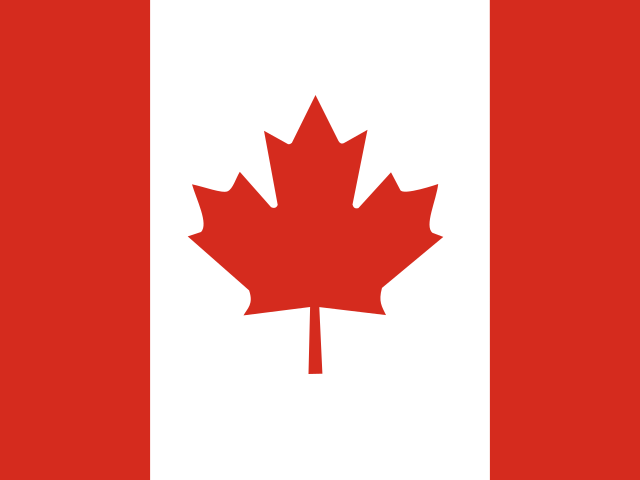
In what year was the current Canadian flag, with the red maple leaf, first raised?
Answer1965
Its red, white and red pattern goes back to the flag of the Royal Military College in Kingston. Red and white became national colours in 1921.
Source: Discover Canada, Canadian Symbols
- 64.
What does Canada's motto, A Mari Usque Ad Mare, mean?
AnswerFrom sea to sea
The motto is on the coat of arms, which was adopted after the First World War.
Source: Discover Canada, Canadian Symbols
- 65.
In what year was O Canada proclaimed the national anthem?
Answer1980
O Canada was first sung in Quebec City in 1880. The royal anthem is God Save the King.
Source: Discover Canada, Canadian Symbols
- 66.
What are Canada's official sports for winter and for summer?
AnswerIce hockey and lacrosse
Lacrosse was first played by Aboriginal peoples. Soccer has the most registered players of any sport in Canada.
Source: Discover Canada, Canadian Symbols
- 67.
Which animal appears on the five cent coin?
AnswerThe beaver
The beaver was a symbol of the Hudson's Bay Company and is on the coats of arms of Saskatchewan and Alberta.
Source: Discover Canada, Canadian Symbols
- 68.
What are Canada's two official languages?
AnswerEnglish and French
Adult applicants for citizenship aged 18 to 54 need adequate knowledge of English or French.
Source: Discover Canada, Canadian Symbols
- 69.
When is Victoria Day?
AnswerThe Monday before May 25
Victoria Day honours the Sovereign's birthday. Canada Day is July 1 and Labour Day is the first Monday of September.
Source: Discover Canada, Canadian Symbols
Regions and economy
- 70.
How many provinces and territories does Canada have?
Answer10 provinces and 3 territories
The territories are Yukon, the Northwest Territories and Nunavut. Each province and territory has its own capital.
Source: Discover Canada, Canada's Regions
- 71.
What is the capital of Canada?
AnswerOttawa
Queen Victoria chose Ottawa as the capital in 1857. It sits on the Ottawa River.
Source: Discover Canada, Canada's Regions
- 72.
Which is Canada's smallest province?
AnswerPrince Edward Island
It is known for its beaches, red soil and potato farms, and is joined to the mainland by the Confederation Bridge.
Source: Discover Canada, Canada's Regions
- 73.
Which three oceans border Canada?
AnswerThe Pacific, the Atlantic and the Arctic
Canada is the second largest country in the world, and its southern border is shared with the United States.
Source: Discover Canada, Canada's Regions
- 74.
Which territory was created in 1999, with a name meaning our land in Inuktitut?
AnswerNunavut
Nunavut's capital is Iqaluit, once called Frobisher Bay. About 85 per cent of its people are Inuit.
Source: Discover Canada, Canada's Regions
- 75.
Which body of water has the highest tides in the world?
AnswerThe Bay of Fundy
The Bay of Fundy lies between Nova Scotia and New Brunswick.
Source: Discover Canada, Canada's Regions
- 76.
Which province is the largest producer of oil and gas?
AnswerAlberta
Alberta's oil sands in the north are a major source of energy. The province is also known for cattle ranching.
Source: Discover Canada, Canada's Regions
- 77.
What is the capital of the Yukon?
AnswerWhitehorse
Yellowknife is the capital of the Northwest Territories and Iqaluit of Nunavut. Canada's highest mountain, Mount Logan, is in the Yukon.
Source: Discover Canada, Canada's Regions
- 78.
Which country is Canada's largest trading partner?
AnswerThe United States
Canada and the United States are each other's largest trading partner, with one of the largest trading relationships in the world.
Source: Discover Canada, Canada's Economy
- 79.
What are Canada's three main types of industry?
AnswerService, manufacturing and natural resources
Service industries employ more than three quarters of working Canadians.
Source: Discover Canada, Canada's Economy
- 80.
Which province is home to more than one third of Canadians?
AnswerOntario
Toronto, Ontario's capital, is Canada's largest city and its main financial centre.
Source: Discover Canada, Canada's Regions
Not affiliated with IRCC or the Government of Canada. Original practice questions based on Discover Canada; check canada.ca before your test.
FAQ
Frequently asked questions
How many questions are on the Canadian citizenship test?
Twenty. They are multiple choice or true or false, and you need 15 correct answers (75 per cent) to pass. You have 45 minutes.
Who has to take the citizenship test?
Applicants who are 18 to 54 years old on the day they sign their application. Applicants under 18 or 55 and over do not take the test.
What should I study for the Canadian citizenship test?
Discover Canada: The Rights and Responsibilities of Citizenship, the official study guide from IRCC. Every test question is based on it. It is free to read online or download on canada.ca.
Is there a new study guide to replace Discover Canada?
Not as of October 2026. IRCC has said for some time that a new guide is being prepared, but canada.ca still names Discover Canada as the guide all test questions are based on. Check the IRCC study page before your test.
What happens if I fail the test?
You get 3 chances to pass. If you do not pass, IRCC may invite you to a retest or to an interview with a citizenship official. Check the test results page on canada.ca for the current rules.
Are these the real test questions?
No. The official questions are not public. We wrote these questions ourselves from facts in Discover Canada, and each one names the chapter it comes from. PoliticalTests is not affiliated with IRCC or the Government of Canada.
★ You know how the system works ★
Now, where do
you stand?
Facts are one half of civics. The other half is what you believe. The Political Compass Test maps your views on 48 statements in about 6 minutes. Free, neutral, no signup.
More knowledge quizzes
- Citizenship test12/20 to pass
US civics test
Twenty random questions from the official 2025 list, the same pass mark as the real interview, and the answer explained after every question.
128 questions in the bank - Citizenship test18/24 to pass
Life in the UK test
Twenty-four random questions, the real pass mark of 18, and every answer explained with the chapter of the official handbook it comes from.
80 questions in the bank - Citizenship test15/20 to pass
Australian citizenship test
Twenty questions with 5 on Australian values, scored like the real test: 15 right overall and every values question right to pass.
73 questions in the bank - Constitution quiz20 Qs
US Constitution quiz
Twenty questions drawn at random from a bank of 60, each answer explained with the Article, section or amendment it rests on.
60 questions in the bank - Constitution quiz15 Qs
Constitution of India quiz
Fifteen questions drawn at random from a bank of 44, each answer explained with the Article, Schedule or amendment it rests on.
44 questions in the bank - Polity quiz20 Qs
Indian polity quiz
Twenty polity MCQs drawn at random from a bank of 67, each answer explained with the Article, Act or judgment it rests on.
67 questions in the bank - Politics quiz20 Qs
UK politics quiz
Twenty questions on how Westminster works, drawn at random from a bank of 58, each answer explained with the Act, rule or ruling behind it.
58 questions in the bank - Politics quiz20 Qs
US politics quiz
Twenty politics trivia questions drawn at random from a bank of 61, each answer explained with the law, Senate rule, case or official result behind it.
61 questions in the bank - Politics quiz20 Qs
EU quiz
Twenty questions on the European Union drawn at random from a bank of 59, each answer explained with the Treaty Article or official source behind it.
59 questions in the bank - All quizzesPolitical quizzes