PoliticalTests
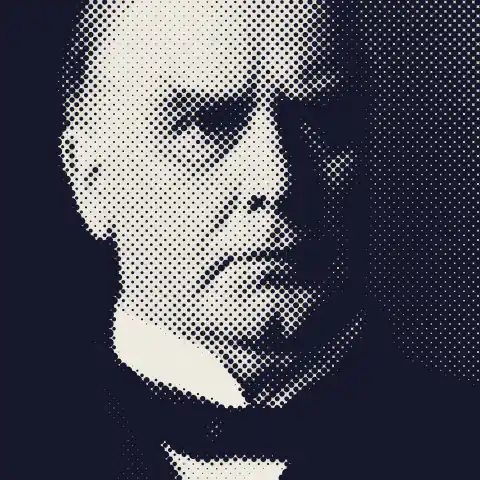
Portrait of William McKinley
1843-1901United States

Portrait: Unknown author, Public domain, via Wikimedia Commons

William McKinley

25th President of the United States (1897-1901) · Governor of Ohio · U.S. Representative from Ohio · Union officer in the Civil War

Twenty-fifth U.S. president who championed protective tariffs and the gold standard, led the United States into war with Spain and acquired an overseas empire, and was assassinated in 1901.

ECONOMYSTATE AND LIBERTYSOCIETYWORLDOwnershipMarketsWelfareAuthoritySecurityStructureMoralityReligionTechnologyCultureTradeForeign
  • Position
  • Solid, past the ring: second pole
  • Short, inside the ring: first pole
  • Balanced

★ William McKinley on 12 axes

Share of each pole

Economy

Equality / Markets
  • OwnershipModerate: Private
    PublicPrivate
  • MarketsMild: Free
    PlannedFree
  • WelfareNo clear record
    SharedSelf-reliant

State and liberty

Liberty / Authority
  • AuthorityBalanced
    DemocraticStrong leader
  • SecurityNo clear record
    LibertyOrder
  • StructureNo clear record
    LocalCentral

Society

Progress / Tradition
  • MoralityNo clear record
    ProgressiveTraditional
  • ReligionNo clear record
    SecularReligious
  • TechnologyNo clear record
    EmbraceCaution
  • CultureNo clear record
    MulticulturalNational identity

World

Global / Nation
  • TradeStrong: Protected
    GlobalProtected
  • Foreign policyStrong: Strength
    CooperationStrength

How we placed it

Judgment calls

Positions summarize typical stances from primary sources and reference works. Where an axis is genuinely contested, the reasoning is below.

Ownership
No public ownership debate in his era; scored from his pro-business Republican program of tariffs and sound money.
Markets
Signed the Gold Standard Act and distinguished between good and bad trusts, proposing no new antitrust legislation.
Welfare
No documented position on federal relief in the sources used here; left null.
Authority
Expanded the president's role in managing war and public opinion, running a White House war room, while working closely with Congress; scored at the middle.
Security
No documented position on civil liberties at home in the sources used here; left null.
Structure
No documented position on the balance between federal and state power; left null.
Morality
No documented position on family or social norms beyond the conventions of his era; left null.
Religion
No documented position on religion in public life in the sources used here; left null.
Technology
No documented view; 19th-century context.
Culture
His supporters' case for empire rested on claims that Filipinos were unfit for self-rule, but his own documented position is not clear in the sources used here; left null.
Trade
Author of the 1890 McKinley Tariff who signed the Dingley Tariff of 1897, though a day before his death he endorsed reciprocal trade treaties.
Foreign policy
Led the country into war with Spain, annexed Hawaii, acquired Puerto Rico, Guam and the Philippines, and waged war against Filipino independence forces.

7 axes are marked as no clear record: there is no reasonable basis to place William McKinley there, so matching leaves them out.

Who was William McKinley?

William McKinley (1843-1901) enlisted as a private in the Union army, rose to major and became an Ohio lawyer, congressman and governor. As chairman of the House Ways and Means Committee he wrote the protective tariff of 1890 that bears his name. Elected president in 1896 against William Jennings Bryan in a campaign over gold and silver, he signed the Dingley Tariff and the Gold Standard Act. In 1898 he led the country into war with Spain over Cuba, and the peace treaty gave the United States Puerto Rico, Guam and the Philippines, where U.S. forces then fought Filipino nationalists seeking independence. Re-elected in 1900, he was shot by an anarchist in Buffalo in September 1901 and died eight days later.

Political views

  • Signed the Dingley Tariff of 1897, which raised rates to protect domestic industry and American workers.

    Source: millercenter.org
  • Signed the Gold Standard Act of 1900, which formally placed U.S. currency on the gold standard.

    Source: millercenter.org
  • Distinguished between good and bad trusts and proposed no new antitrust legislation.

    Source: millercenter.org
  • Led the United States into the 1898 war with Spain, which ended with the acquisition of Puerto Rico, Guam and the Philippines.

    Source: millercenter.org
  • Decided to keep the Philippines and waged war against Filipino forces fighting for independence.

    Source: history.state.gov
  • Announced his support for reciprocal trade treaties in 1901, a day before he was shot.

    Source: millercenter.org

Legacy

Admirers credit McKinley with ending the depression-era battles over money, presiding over prosperity and turning the United States into a world power, and some historians see him as the first modern president for his management of the press and of war. Anti-imperialists of his time, including Mark Twain, Andrew Carnegie and former President Benjamin Harrison, argued that acquiring colonies betrayed American principles. The war against Filipino independence forces that began in 1899 under his administration and continued until 1902 was far deadlier than the war with Spain: the State Department's Office of the Historian reports that as many as 200,000 Filipino civilians died from violence, famine and disease. Critics also note that he did little to oppose the spread of segregation and lynching in the South.

★ 12 Axes Political Test ★

How close are you to William McKinley?

Answer plain statements on 12 axes and see your match with William McKinley and every other profile on the site, axis by axis.

FAQ

William McKinley: questions

What political party was William McKinley?

McKinley was a Republican. He defeated Democrat William Jennings Bryan in 1896 and again in 1900.

What was the Philippine-American War?

After Spain ceded the Philippines in 1898, Filipino nationalists who had declared independence fought U.S. forces from 1899. Organized resistance ended by 1902, after heavy civilian losses.

How did William McKinley die?

He was shot by the anarchist Leon Czolgosz at the Pan-American Exposition in Buffalo on September 6, 1901, and died on September 14. Theodore Roosevelt succeeded him.