PoliticalTests
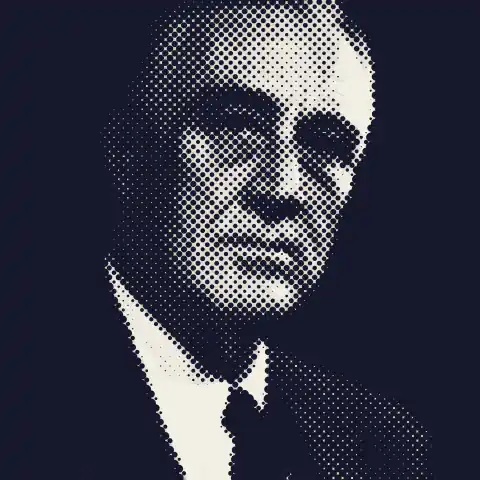
Portrait of Franklin D. Roosevelt
1882-1945United States

Portrait: Leon Perskie, CC BY 2.0, via Wikimedia Commons. Halftone version: CC BY 2.0

Franklin D. Roosevelt

32nd President of the United States (1933-1945) · Governor of New York · Assistant Secretary of the Navy

Democratic president who led the United States through the Great Depression and World War II, creating the New Deal and helping plan the United Nations.

ECONOMYSTATE AND LIBERTYSOCIETYWORLDOwnershipMarketsWelfareAuthoritySecurityStructureMoralityReligionTechnologyCultureTradeForeign
  • Position
  • Solid, past the ring: second pole
  • Short, inside the ring: first pole
  • Balanced

★ Franklin D. Roosevelt on 12 axes

Share of each pole

Economy

Equality / Markets
  • OwnershipMild: Public
    PublicPrivate
  • MarketsModerate: Planned
    PlannedFree
  • WelfareModerate: Shared
    SharedSelf-reliant

State and liberty

Liberty / Authority
  • AuthorityMild: Strong leader
    DemocraticStrong leader
  • SecurityModerate: Order
    LibertyOrder
  • StructureModerate: Central
    LocalCentral

Society

Progress / Tradition
  • MoralityMild: Traditional
    ProgressiveTraditional
  • ReligionMild: Religious
    SecularReligious
  • TechnologyMild: Embrace
    EmbraceCaution
  • CultureMild: National identity
    MulticulturalNational identity

World

Global / Nation
  • TradeModerate: Global
    GlobalProtected
  • Foreign policyModerate: Cooperation
    CooperationStrength

How we placed it

Judgment calls

Positions summarize typical stances from primary sources and reference works. Where an axis is genuinely contested, the reasoning is below.

Authority
Won four elections within constitutional processes, but his 1937 plan to enlarge the Supreme Court and broad emergency powers push the score positive.
Security
The wartime relocation of more than 110,000 Americans of Japanese descent weighs heavily here.
Technology
Inferred from public power projects such as the TVA and wartime science programs; he set out no explicit technology philosophy.
Culture
Mixed: a pluralist New Deal coalition alongside wartime internment and continuation of the 1924 immigration quotas.
Foreign policy
Built wartime alliances and planned the United Nations while overseeing the largest U.S. military buildup to that date.

Who was Franklin D. Roosevelt?

Franklin Delano Roosevelt (1882-1945), a Democrat and former governor of New York, was elected president in 1932 during the Great Depression and re-elected in 1936, 1940 and 1944, the only president to serve more than two terms. His New Deal created relief, public works, financial regulation, labor rights and social insurance programs that greatly expanded the federal government's role in the economy. From December 1941 he led the country in World War II in alliance with Britain and the Soviet Union, and he died in office in April 1945.

Political views

  • Signed the Social Security Act of 1935, creating federal old-age insurance and unemployment insurance.

    Source: millercenter.org
  • Backed the Wagner Act, which protected workers' right to organize and created the National Labor Relations Board.

    Source: millercenter.org
  • Created the Tennessee Valley Authority, a federally owned corporation that built dams and supplied electricity to one of the poorest regions of the country.

    Source: millercenter.org
  • Established the Securities and Exchange Commission in 1934 to regulate financial markets.

    Source: millercenter.org
  • Proposed in 1937 to add justices to the Supreme Court after it struck down New Deal laws; the plan failed in Congress.

    Source: millercenter.org
  • Won passage of the Reciprocal Trade Agreements Act of 1934, allowing tariff reductions through bilateral agreements.

    Source: millercenter.org
  • Supported Britain through Lend-Lease, issued the Atlantic Charter and promoted a postwar United Nations organization.

    Source: millercenter.org

Legacy

Admirers regard Roosevelt as having restored public confidence during the Depression, built the American social safety net and led a coalition that defeated Nazi Germany and Imperial Japan, and he is often ranked among the top presidents. Critics, especially conservatives and libertarians, argue that the New Deal expanded federal power beyond constitutional limits, slowed recovery through regulation and created lasting fiscal commitments. His court plan and four terms contributed to the later two-term limit. His administration's relocation of Japanese Americans is widely viewed today as a serious violation of civil liberties.

In their words

The only thing we have to fear is fear itself.
First Inaugural Address, 1933

★ 12 Axes Political Test ★

How close are you to Franklin D. Roosevelt?

Answer plain statements on 12 axes and see your match with Franklin D. Roosevelt and every other profile on the site, axis by axis.

FAQ

Franklin D. Roosevelt: questions

What political party was Franklin D. Roosevelt?

Roosevelt was a Democrat. He won four presidential elections, in 1932, 1936, 1940 and 1944.

What was the New Deal?

The New Deal was the set of programs Roosevelt enacted in response to the Great Depression. It included relief and public works, banking and securities regulation, labor protections and Social Security.

Was FDR a socialist?

No. Roosevelt was a Democrat who sought to reform and stabilize a market economy rather than replace it. Some opponents called parts of the New Deal socialist, while Socialist Party leaders argued it did not go far enough.

Sources

  1. 01millercenter.org
  2. 02millercenter.org
  3. 03millercenter.org
  4. 04millercenter.org
  5. 05presidency.ucsb.edu

Image credits

Portrait of Franklin D. Roosevelt: FDR 1944 Color Portrait.jpg by Leon Perskie, licensed CC BY 2.0, via Wikimedia Commons. Cropped, converted to grayscale and printed as a halftone by politicaltests.org; the halftone version is licensed CC BY 2.0.

All portrait credits and licenses