PoliticalTests
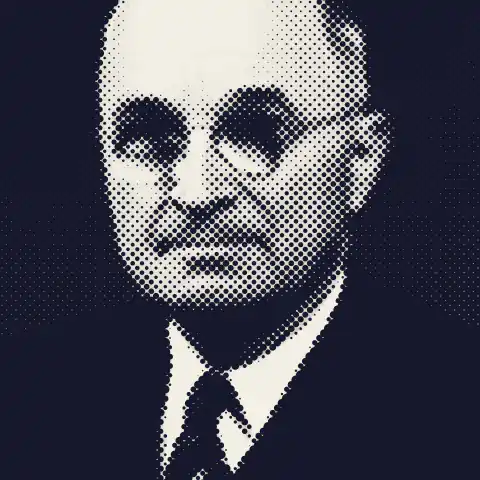
Portrait of Harry S. Truman
1884-1972United States

Portrait: National Archives and Records Administration, Public domain, via Wikimedia Commons

Harry S. Truman

33rd President of the United States (1945-1953) · Vice President of the United States · U.S. Senator from Missouri · Artillery officer in World War I

Thirty-third U.S. president who ordered the atomic bombings of Japan, launched the containment policy, the Marshall Plan and NATO, proposed the Fair Deal and desegregated the armed forces.

ECONOMYSTATE AND LIBERTYSOCIETYWORLDOwnershipMarketsWelfareAuthoritySecurityStructureMoralityReligionTechnologyCultureTradeForeign
  • Position
  • Solid, past the ring: second pole
  • Short, inside the ring: first pole
  • Balanced

★ Harry S. Truman on 12 axes

Share of each pole

Economy

Equality / Markets
  • OwnershipMild: Public
    PublicPrivate
  • MarketsModerate: Planned
    PlannedFree
  • WelfareModerate: Shared
    SharedSelf-reliant

State and liberty

Liberty / Authority
  • AuthorityMild: Strong leader
    DemocraticStrong leader
  • SecurityMild: Order
    LibertyOrder
  • StructureModerate: Central
    LocalCentral

Society

Progress / Tradition
  • MoralityNo clear record
    ProgressiveTraditional
  • ReligionNo clear record
    SecularReligious
  • TechnologyNo clear record
    EmbraceCaution
  • CultureModerate: Multicultural
    MulticulturalNational identity

World

Global / Nation
  • TradeModerate: Global
    GlobalProtected
  • Foreign policyMild: Strength
    CooperationStrength

How we placed it

Judgment calls

Positions summarize typical stances from primary sources and reference works. Where an axis is genuinely contested, the reasoning is below.

Ownership
Proposed development projects modeled on the Tennessee Valley Authority and seized the steel industry in 1952, though within a private economy.
Markets
Favored keeping price controls after World War II and vetoed the Taft-Hartley limits on unions.
Welfare
His Fair Deal called for national health insurance, a larger Social Security system and a higher minimum wage.
Authority
Seized the steel mills during the Korean War without congressional authorization, a move the Supreme Court struck down in 1952.
Security
Created a federal loyalty program to root out Communists, which he later privately called a mistake, while vetoing the McCarran Internal Security Act and denouncing Senator McCarthy.
Structure
Pushed federal civil rights action and an expanded national role in the economy.
Morality
No documented position on family or social norms in the sources used here; left null.
Religion
No documented program on religion in public life in the sources used here; left null.
Technology
The decision to use the atomic bomb is scored under foreign policy; no broader view on technology policy, so left null.
Culture
Desegregated the armed forces and the federal workforce by executive order and called for liberalized immigration laws.
Trade
Rejected a Republican effort to raise tariffs on imported wool as isolationist and continued the reciprocal trade program.
Foreign policy
Ordered the atomic bombings of Japan and sent troops to Korea, while building the United Nations, the Marshall Plan and NATO; scored toward strength within alliances.

3 axes are marked as no clear record: there is no reasonable basis to place Harry S. Truman there, so matching leaves them out.

Who was Harry S. Truman?

Harry S. Truman (1884-1972) farmed in Missouri, commanded an artillery battery in World War I and ran a failed haberdashery before entering politics through the Kansas City Democratic organization. As a senator he led a committee that investigated waste in war production. Chosen as Franklin D. Roosevelt's running mate in 1944, he became president when Roosevelt died in April 1945. He presided over the end of World War II, including the decision to use atomic bombs on Japan, and the start of the Cold War. In 1948 he won an upset victory over Thomas Dewey. His second term was dominated by the Korean War and fears of Communist subversion, and he did not seek re-election in 1952.

Political views

  • Approved the use of atomic bombs against Hiroshima and Nagasaki in August 1945, shortly before Japan surrendered.

    Source: millercenter.org
  • Proposed the Fair Deal, including national health insurance, a larger Social Security system and a higher minimum wage.

    Source: millercenter.org
  • Vetoed the Taft-Hartley Act of 1947, saying it would take fundamental rights away from working people; Congress overrode him.

    Source: millercenter.org
  • Ordered the desegregation of the armed forces in 1948 with Executive Order 9981.

    Source: archives.gov
  • Created a federal loyalty security program in 1946 to identify Communists in government.

    Source: millercenter.org
  • Announced the Truman Doctrine in 1947, pledging support for governments resisting Communist pressure, beginning with Greece and Turkey.

    Source: millercenter.org
  • Seized the steel industry in 1952 to avert a wartime strike, an action the Supreme Court ruled unconstitutional.

    Source: millercenter.org

Legacy

Truman left office deeply unpopular, but historians now usually rank him among the more successful presidents, crediting him with the Marshall Plan, NATO and the containment strategy that framed the Cold War, and with an early federal commitment to civil rights. Critics on the left argue that his loyalty program and rhetoric fed the anticommunist fear of the McCarthy era, and critics on the right faulted him for the stalemate in Korea and for firing General Douglas MacArthur. His decision to use atomic bombs on Hiroshima and Nagasaki, which immediately killed upwards of 100,000 people, most of them civilians, remains one of the most debated choices in modern history: supporters argue it ended the war and averted an invasion of Japan, while critics argue that Japan was close to surrender and that targeting cities was unjustifiable.

★ 12 Axes Political Test ★

How close are you to Harry S. Truman?

Answer plain statements on 12 axes and see your match with Harry S. Truman and every other profile on the site, axis by axis.

FAQ

Harry S. Truman: questions

What political party was Harry S. Truman?

Truman was a Democrat. He succeeded Franklin D. Roosevelt in 1945 and won a full term in 1948.

Why did Truman use the atomic bomb?

Truman said he approved the bombings to end the war quickly and avoid an invasion of Japan that was expected to cost many American and Japanese lives. Historians continue to debate whether other options would have brought a surrender.

What was the Fair Deal?

Truman's domestic program, which called for national health insurance, expanded Social Security, a higher minimum wage, public housing and civil rights legislation. Congress passed only parts of it.