Ayn Rand vs Karl Marx

Ayn Rand
 United States
- Novelist and philosopher
- Author of The Fountainhead and Atlas Shrugged
Russian-born American novelist and philosopher who founded Objectivism and defended laissez-faire capitalism, individual rights and rational self-interest.
Full profile of Ayn Rand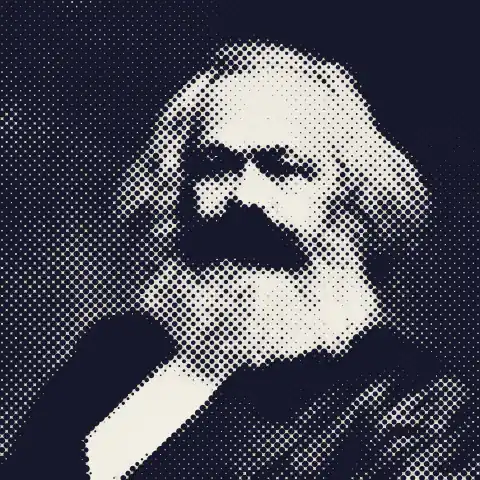
Karl Marx
 Germany
- Philosopher
- Economist
Karl Marx was a German philosopher and economist whose critique of capitalism and theory of class struggle became the foundation of Marxism and of most 20th-century communist movements.
Full profile of Karl MarxIn short
How they compare
Ayn Rand (1905-1982) and Karl Marx (1818-1883) are a 51% match on the 12 axes where both have a clear record.
They differ most on ownership (Ayn Rand: private (strong); Karl Marx: public (strong)), markets (Ayn Rand: free (strong); Karl Marx: planned (strong)) and welfare (Ayn Rand: self-reliant (strong); Karl Marx: shared (strong)). They are closest on religion, morality and technology.
On the economy Ayn Rand sits further toward markets; on state and liberty Karl Marx sits further toward authority; on society their positions are close; on the world stage Karl Marx sits further toward nation.
Generated from the two sourced profiles on this site. Each axis placement and its reasoning is on the full profile pages.
★ By family of axes
- Economy3 axes
- Ayn Randmarkets (strong)Karl Marxequality (strong)
- State and liberty3 axes
- Ayn Randliberty (mild)Karl Marxauthority (mild)
- Society4 axes
- Ayn Randprogress (moderate)Karl Marxprogress (moderate)
- World2 axes
- Ayn Randglobal (moderate)Karl Marxglobal (mild)
- Ayn Rand: petals and stars
- Karl Marx: dashed outline
★ Where they differ most
- Ownership185 points apart
Ayn Rand: Private (strong). Karl Marx: Public (strong).
- Markets185 points apart
Ayn Rand: Free (strong). Karl Marx: Planned (strong).
- Welfare180 points apart
Ayn Rand: Self-reliant (strong). Karl Marx: Shared (strong).
- Trade60 points apart
Ayn Rand: Global (strong). Karl Marx: Global (mild).
★ Where they are closest
- Religion · 0 apart
- Foreign policy · 20 apart
- Technology · 20 apart
Axis by axis
Karl Marx
Economy
Equality / Markets- OwnershipStrong: Private5%95%PublicPrivate
- MarketsStrong: Free3%97%PlannedFree
- WelfareStrong: Self-reliant3%97%SharedSelf-reliant
State and liberty
Liberty / Authority- AuthorityMild: Democratic65%35%DemocraticStrong leader
- SecurityModerate: Liberty68%32%LibertyOrder
- StructureBalanced50%50%LocalCentral
Society
Progress / Tradition- MoralityModerate: Progressive70%30%ProgressiveTraditional
- ReligionStrong: Secular88%12%SecularReligious
- TechnologyStrong: Embrace90%10%EmbraceCaution
- CultureMild: Multicultural65%35%MulticulturalNational identity
World
Global / Nation- TradeStrong: Global95%5%GlobalProtected
- Foreign policyMild: Strength40%60%CooperationStrength
★ 12 Axes Political Test ★
Who are you closer to?
Answer plain statements on 12 axes and see your match with Ayn Rand, Karl Marx and every other historical figure, axis by axis.
FAQ
Ayn Rand vs Karl Marx
What is the difference between Ayn Rand and Karl Marx?
They differ most on ownership (Ayn Rand: private (strong); Karl Marx: public (strong)), markets (Ayn Rand: free (strong); Karl Marx: planned (strong)) and welfare (Ayn Rand: self-reliant (strong); Karl Marx: shared (strong)). On the economy Ayn Rand sits further toward markets; on state and liberty Karl Marx sits further toward authority; on society their positions are close; on the world stage Karl Marx sits further toward nation.
What do Ayn Rand and Karl Marx have in common?
They are closest on religion, morality and technology. Overall their profiles are a 51% match on the 12 axes where both have a clear record.
Who leans more toward free markets, Ayn Rand or Karl Marx?
On the economic axes they share, Ayn Rand sits further toward markets and Karl Marx further toward equality. Ayn Rand reads as markets (strong) overall, Karl Marx as equality (strong).
Am I closer to Ayn Rand or Karl Marx?
Take the 12 Axes Political Test. Your result shows your match with both of them, and with every other historical figure and ideology on the site, axis by axis.