PoliticalTests
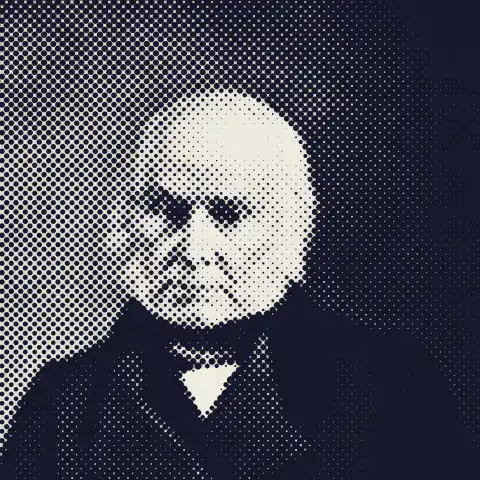
Portrait of John Quincy Adams
1767-1848United States

Portrait: jklamo Cleaned and enhanced by Julielangford, Public domain, via Wikimedia Commons

John Quincy Adams

6th President of the United States (1825-1829) · U.S. Secretary of State · U.S. Representative from Massachusetts · Diplomat

Sixth U.S. president and son of John Adams who proposed an ambitious federal program of roads, canals and science, and later fought the gag rule on slavery petitions as a congressman.

ECONOMYSTATE AND LIBERTYSOCIETYWORLDOwnershipMarketsWelfareAuthoritySecurityStructureMoralityReligionTechnologyCultureTradeForeign
  • Position
  • Solid, past the ring: second pole
  • Short, inside the ring: first pole
  • Balanced

★ John Quincy Adams on 12 axes

Share of each pole

Economy

Equality / Markets
  • OwnershipMild: Private
    PublicPrivate
  • MarketsMild: Planned
    PlannedFree
  • WelfareMild: Self-reliant
    SharedSelf-reliant

State and liberty

Liberty / Authority
  • AuthorityModerate: Democratic
    DemocraticStrong leader
  • SecurityModerate: Liberty
    LibertyOrder
  • StructureModerate: Central
    LocalCentral

Society

Progress / Tradition
  • MoralityNo clear record
    ProgressiveTraditional
  • ReligionNo clear record
    SecularReligious
  • TechnologyModerate: Embrace
    EmbraceCaution
  • CultureNo clear record
    MulticulturalNational identity

World

Global / Nation
  • TradeModerate: Protected
    GlobalProtected
  • Foreign policyMild: Cooperation
    CooperationStrength

How we placed it

Judgment calls

Positions summarize typical stances from primary sources and reference works. Where an axis is genuinely contested, the reasoning is below.

Markets
Proposed an active federal role in building a national market through roads, canals and other public works, within a private economy.
Welfare
No federal welfare system existed; the score reflects his support for federal investment in education and science rather than redistribution.
Security
Scored toward liberty for his long fight in Congress against the gag rule on antislavery petitions and his defense of the Amistad captives.
Morality
His later opposition to slavery is covered elsewhere; no documented position on family or social norms beyond his era's conventions, so left null.
Religion
Personally devout, but no documented program on religion in public life in the sources used here; left null.
Technology
Scored toward embrace for his proposals for a national observatory, a national university and federally backed internal improvements.
Culture
No documented position on immigration or cultural pluralism in the sources used here; left null.
Trade
Accepted the highly protective Tariff of 1828, which was stricter than he would have preferred, within a broader commitment to the American System.
Foreign policy
A career diplomat who favored negotiated settlements and sent delegates to the 1826 Panama Congress; as secretary of state he also helped draft the unilateral Monroe Doctrine.

3 axes are marked as no clear record: there is no reasonable basis to place John Quincy Adams there, so matching leaves them out.

Who was John Quincy Adams?

John Quincy Adams (1767-1848), the son of President John Adams, spent much of his early life as a diplomat in Europe, helped negotiate the Treaty of Ghent that ended the War of 1812 and served as secretary of state under James Monroe. He won the disputed 1824 election in the House of Representatives after no candidate gained an electoral majority, and Andrew Jackson's supporters accused him of a corrupt bargain with Henry Clay. As president he proposed a national program of internal improvements, education and science that Congress largely rejected, and he lost to Jackson in 1828. From 1831 until his death he served in the House, where he became a leading opponent of slavery's political power.

Political views

  • Proposed in 1825 a national program of roads, canals, a national university and an astronomical observatory, arguing that liberty is power.

    Source: millercenter.org
  • Backed federally funded internal improvements and the protective tariffs of Henry Clay's American System.

    Source: millercenter.org
  • Accepted the Tariff of 1828, called the Tariff of Abominations by its Southern opponents, which raised duties above what he had proposed.

    Source: millercenter.org
  • Sought to send delegates to the Panama Congress of the new Latin American republics over strong objections from Southern members of Congress.

    Source: millercenter.org
  • As a congressman, was instrumental in ending the House gag rule that prohibited debate on slavery.

    Source: millercenter.org
  • Argued before the Supreme Court in 1841 for the freedom of the Africans who had seized the slave ship Amistad.

    Source: history.state.gov

Legacy

Historians widely regard Adams as one of the most accomplished diplomats in U.S. history, crediting him with the Adams-Onís Treaty and much of the thinking behind the Monroe Doctrine. Admirers also point to his vision of federal support for science, education and transportation, which anticipated later national programs, and to his post-presidential defense of the right of petition and of the Amistad captives. Critics in his own time saw his program as an overreach of federal power, and Jacksonians condemned the 1824 election as a corrupt bargain. Many historians judge his presidency itself unsuccessful, citing his poor relations with Congress and his reluctance to use patronage or build a party, and the 1828 tariff deepened Southern resentment that fed the Nullification Crisis.

In their words

Let us not be unmindful that liberty is power; that the nation blessed with the largest portion of liberty must in proportion to its numbers be the most powerful nation upon earth.
First Annual Message to Congress, 1825

★ 12 Axes Political Test ★

How close are you to John Quincy Adams?

Answer plain statements on 12 axes and see your match with John Quincy Adams and every other profile on the site, axis by axis.

FAQ

John Quincy Adams: questions

What political party was John Quincy Adams?

He began as a Federalist, served as a Democratic-Republican, and as president led the faction that became the National Republicans. In Congress he was associated with the Whigs and the antislavery cause.

Why was the 1824 election called a corrupt bargain?

No candidate won an electoral majority, so the House chose Adams over Andrew Jackson, who had more popular and electoral votes. When Adams then named Henry Clay secretary of state, Jackson's supporters charged that the two had made a deal.

Was John Quincy Adams against slavery?

Yes, increasingly so. In the House he fought the gag rule on antislavery petitions for eight years and argued the Amistad case for the freedom of enslaved Africans before the Supreme Court.